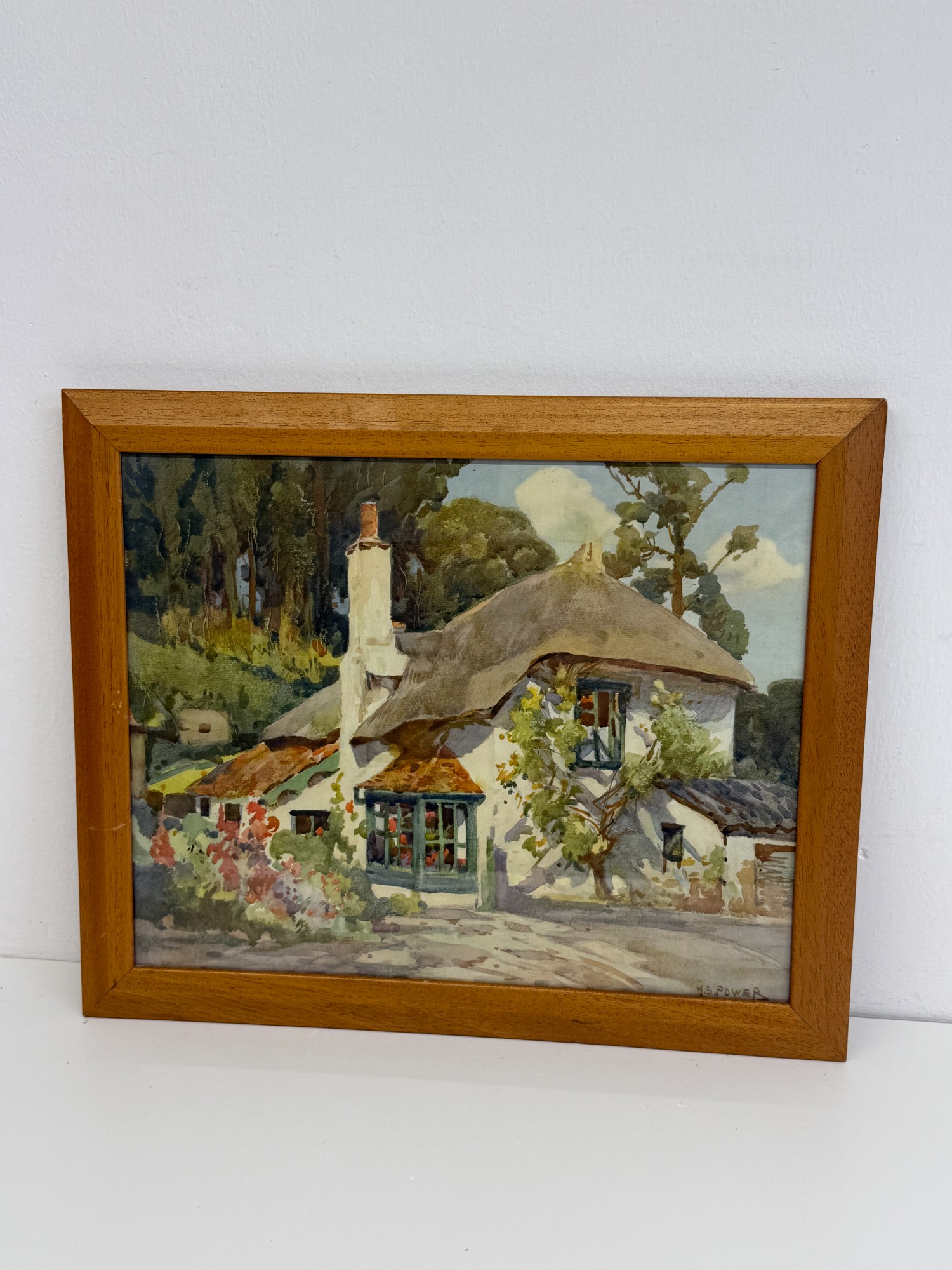
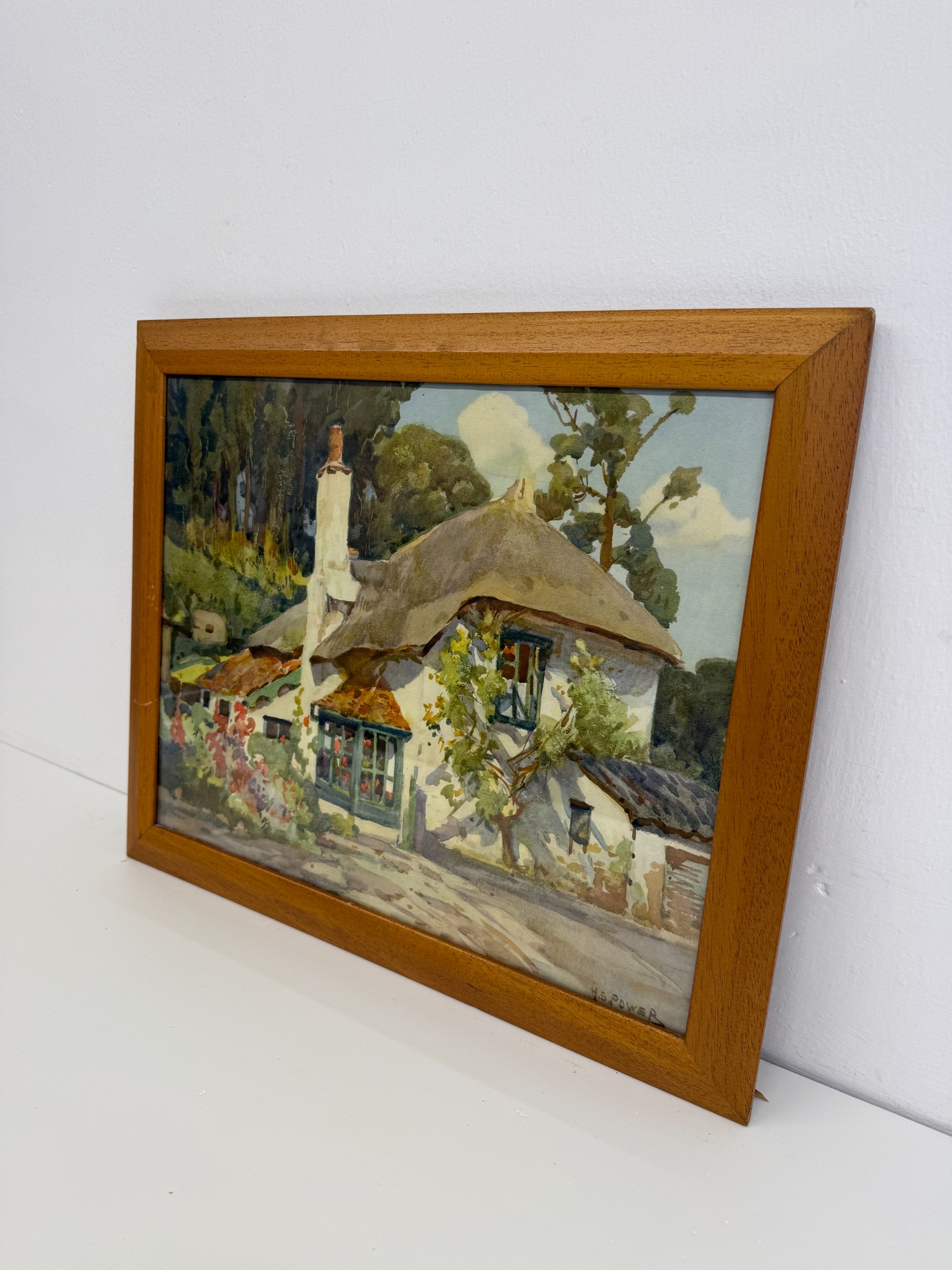
Picture – HAROLD SEPTIMUS POWER / Rural Building in Bossington (Print)
ID: s42576
Category: Paintings
Subcategory: Prints
Location: New store
| Dimensions(cm): | |
| Height: | 48 |
| Width: | 58 |
| Depth: | 2 |
Condition: Used
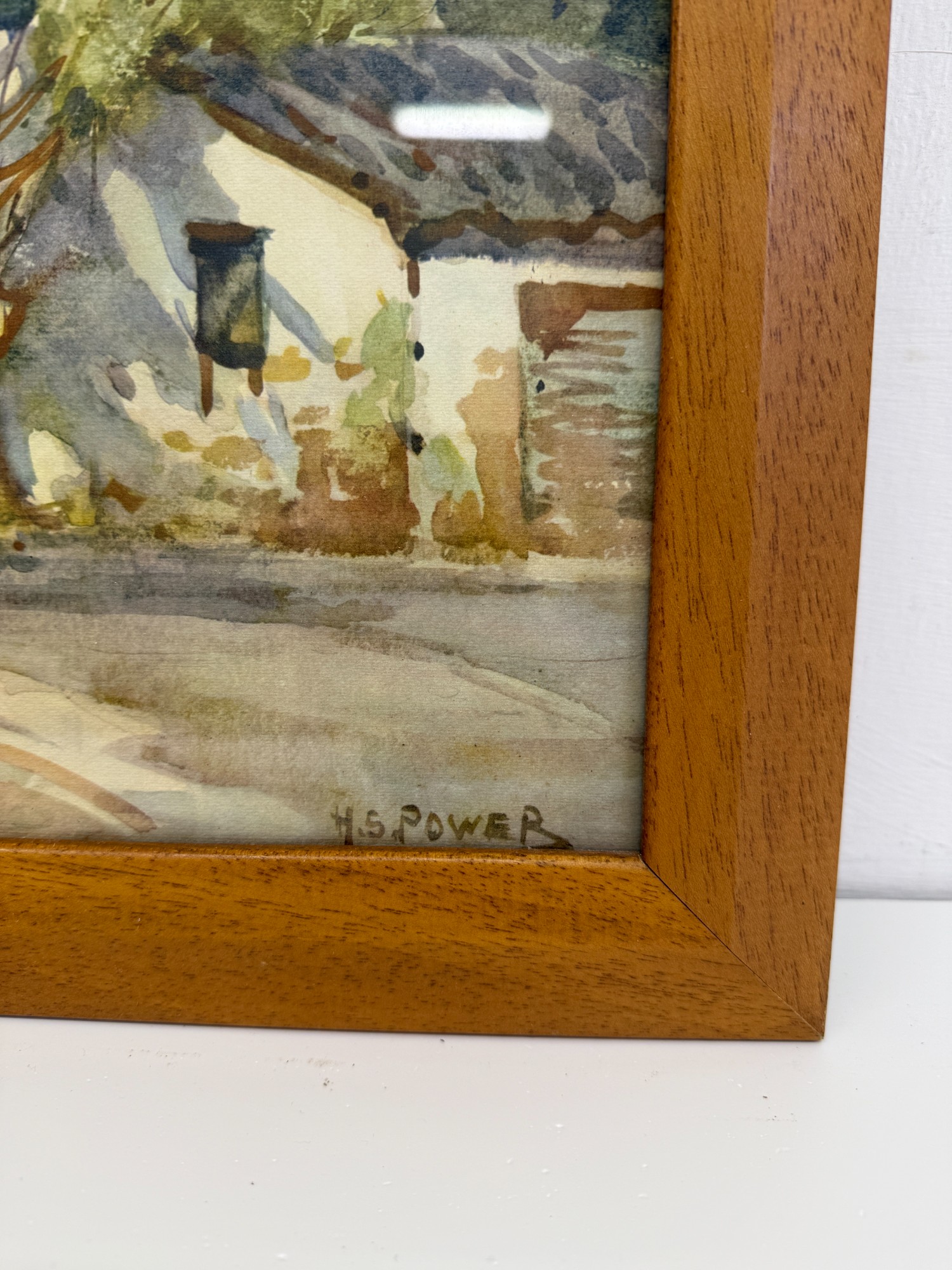
Description: This period reproduction depicts a traditional English thatched cottage, a typical example of the artist's work from his time in England. The scene originates from the picturesque village of Bossington in Hampshire, where the artist often went to paint en plein air during the early phase of his European career, around 1905–1912. The composition is dominated by the white facade of the building with a prominent projecting ground-floor window, climbing greenery, and a massive chimney, while the background consists of dense tree crowns under a clear sky with light clouds. The painting stands out with its relaxed yet precise brushwork, in which the artist masterfully utilizes the transparency of watercolor paints to capture natural daylight and subtle shadows on the house's plaster. The detailed depiction of wild vegetation and flowers in the left foreground adds vibrancy and depth to the entire scene without disturbing the overall harmonious impression of rural tranquility. The style of the work reflects the tradition of British and Australian Impressionism with an emphasis on the luminous atmosphere of the landscape. The work is framed under glass in a simple wooden profiled frame of a light shade, which complements the natural color palette of the watercolor itself. In the lower right corner, there is an authentic, clearly legible artist's signature in an olive-brown tone: H. S. POWER. The painting is in good collector's condition, showing only a slight patina, with the colors retaining their freshness without significant fading or signs of water damage. Harold Septimus Power was a significant New Zealand native who established himself as one of Australia's leading painters of the first half of the 20th century. Born in Dunedin, he began his artistic career in Melbourne and Adelaide. Between 1905 and 1907, he studied at the prestigious Académie Julian in Paris, from where he subsequently moved to London. Here he became a member of the Royal Institute of Oil Painters and regularly exhibited at salons including the Royal Academy of Arts. During World War I, he served as an official war artist for the Australian Imperial Force (A.I.F.) on the European front, where he became renowned for his monumental and dynamic paintings of horses and artillery in battlefields. After the war, he was among the most sought-after and highest-paid traditional artists in Australia. His works are now represented in major public institutions such as the Australian War Memorial in Canberra and the National Gallery of Victoria in Melbourne. Besides dynamic scenes with horse-drawn teams, his more intimate plein-air watercolors with motifs of the English countryside are highly valued collector's items on the international art market.
900 Kč / €38